
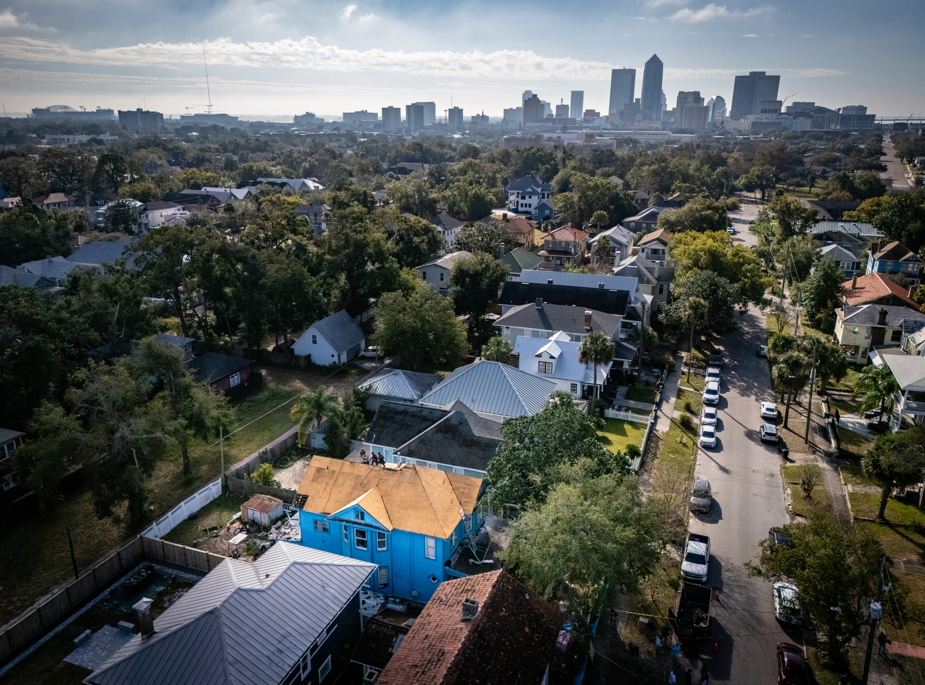
Roof Replacement in Jacksonville, FL
When your roof reaches the end of its service life in Jacksonville, you're not just dealing with shingles. You're dealing with Florida Building Code requirements, permit applications through Duval County or your applicable municipality, insurance implications that will follow your home for years, and a contractor market full of companies that won't be around when something goes wrong.
A roof replacement is the single largest exterior investment most Jacksonville homeowners will make. The contractor you choose, the materials they specify, and the installation details they either do or skip over determine whether your next roof lasts 15 years or 30 — and whether your insurance carrier stays on board after the job is done.
NEXGEN Roofing has been doing this in Jacksonville since 2018. Every replacement we complete is fully permitted, city-inspected, photo and video documented from start to finish, and backed by a written 10-year workmanship warranty. Not a verbal promise. Not a marketing line. A signed contract.
As a local Jacksonville roofing company, we know Duval county better than most - ensuring that our work is done right, the first time.
Is It Time to Replace Your Roof?
This is the question most Jacksonville homeowners struggle with. Repair costs keep adding up and at some point the math flips — but knowing exactly when that happens requires understanding a few Florida-specific factors that most general roofing guides don't cover.
Age is the starting point, not the finish line.
Asphalt shingles in Jacksonville's climate typically perform well for 20–30 years when properly installed with quality materials. But Florida's intense UV exposure, humidity, heat cycling, and hurricane-season wind events accelerate wear in ways that the national average doesn't account for. A 15-year-old shingle roof in Jacksonville that's been through multiple named storm seasons is a fundamentally different animal than a 15-year-old roof in Ohio.
Florida's 15-year roof rule adds a layer most homeowners don't expect.
Insurance carriers in Florida are prohibited from requiring replacement solely based on age if the roof has at least 5 years of remaining useful life — but many carriers have tightened their underwriting standards for roofs approaching or past 15 years old. A roof that triggers non-renewal notices from your insurer, or that fails a 4-point inspection required for home sale or insurance requalification, has effectively crossed the line from "monitor it" into "replace it."
The repair-vs-replace calculation.
The standard rule of thumb is that when repair costs exceed 30% of replacement cost, replacement is the better financial decision. But there's a more practical way to think about it in Jacksonville: if your roof has less than 5 years of useful life remaining and you're investing in repairs, you're essentially paying twice — once to buy time, and again when the replacement becomes unavoidable. We help you understand what it takes to repair a leak in your roof because of our free onsite roofing inspections that are performed by the best roofers in Jacksonville.
Signs that typically point toward replacement rather than repair:
Shingles are granule-depleted across the majority of the roof surface — not just isolated patches
Decking feels soft or spongy when walked (sign of moisture infiltration at the substrate level)
Multiple leak points across different roof areas rather than a single isolated failure
The roof is approaching or past 20 years with no prior replacement
Your insurer has issued a non-renewal notice or required a 4-point inspection
You're preparing to sell and a buyer's inspection has flagged the roof's condition
You've repaired the same area twice in the past three years
The NEXGEN Roof Replacement Process — Step by Step
Every NEXGEN replacement follows the same documented process, regardless of job size or neighborhood. Here's exactly what happens from your first call to your closed permit.
Free Roof Inspection
A NEXGEN project manager — not a salesperson — comes to your home and conducts a full inspection: drone aerial of the entire roof surface, attic check for moisture and ventilation issues, flashing inspection at all penetrations and transitions, and a written photo report. You get the results in plain language. No pressure, no pitch.
Written Estimate & Material Selection
You receive a written scope of work — not a ballpark number over the phone. We walk through material options (shingles, metal, tile), color selection, and warranty tiers. If you need a faster starting point, our Instant Roof Quote tool gives you a satellite-based estimate in under two minutes.
Permit Application
NEXGEN handles every permit application with Duval County or your applicable municipality. We submit drawings, product approvals, and all required documentation. The permit cost is included in our contract — there are no add-on fees at closeout. Under Florida law, a full roof replacement without a permit is a serious issue that can affect your homeowner's insurance coverage, your ability to sell your home, and your eligibility for storm damage claims.
Pre-Job Site Preparation
On installation day, our crew arrives early. Protective tarps go down over all landscaping, HVAC equipment, and hardscaping before any tear-off begins. A magnet nail roller is staged and ready. Dumpster or trailer placement is coordinated to protect your driveway. None of this is optional — it's standard on every job.
Complete Tear-Off
We remove the entire existing roofing system down to the deck — not over-roofing. Florida Building Code restricts the number of shingle layers permitted, and installing over an existing system without removal hides deck damage and compromises the integrity of the new installation. Everything comes off clean.
Decking Inspection & Repair
Once the deck is exposed, we do a full visual and physical inspection of every panel. Any soft spots, delamination, rot, or structural compromise gets documented, discussed with you, and replaced before anything else goes on. Skipping this step is one of the most common shortcuts in the roofing industry — it's how a new roof develops problems within the first year.
Florida Code–Compliant Underlayment
Florida requires a secondary water barrier on all new roofs — this is not optional, and it's not something all contractors do correctly. NEXGEN installs a custom NEXGEN branded underlayment that functions as a standalone water barrier even if the primary shingle layer is compromised in a storm event. Valleys and penetrations get additional ice-and-water shield for reinforced protection at high-risk areas.
Drip Edge, Flashing & Ventilation
New drip edge is installed at all eaves and rakes before shingles go on — not after, which is the incorrect sequence that leads to water intrusion behind the fascia. Step flashing at every wall intersection and chimney is replaced, not reused. Ridge ventilation is calculated per Florida Building Code's ventilation ratios for your specific attic square footage — under-ventilated attics accelerate shingle deterioration and void manufacturer warranties.
Shingle, Metal, or Tile Installation
Installation follows manufacturer specifications exactly — nail pattern, exposure, fastener placement, and hip and ridge cap detailing. For shingle roofs, we use Owens Corning Duration Series with SureNail technology rated to 130 mph. For metal, we install 24-gauge standing seam panels. For tile, we use engineered fasteners rated for Florida's coastal wind zones. Every penetration is flashed and sealed.
Final Walkthrough & Magnet Sweep
Before we leave, a project manager does a final walkthrough of the finished roof with you. Every penetration, valley, transition, and ridge line is inspected. A commercial magnetic roller then sweeps the entire yard, driveway, and landscaped areas for roofing nails. The job site leaves cleaner than it arrived.
City Inspection
NEXGEN schedules the required county or municipal inspection and handles all coordination. The city inspector independently verifies that the installation meets Florida Building Code. You receive the approved inspection documentation for your records — this is what your insurance carrier will ask for, and what a buyer's title company will require if you ever sell.
Warranty Registration & Documentation Package
NEXGEN registers your Owens Corning manufacturer warranty directly with the factory. You receive a complete documentation package: the signed contract, permit and inspection records, before-and-after photo report, manufacturer warranty certificate, and NEXGEN's 10-year workmanship warranty. This package has real value — it's used for insurance claims, home sales, and any future warranty work.
What Makes a Quality Replacement — The Technical Details Most Contractors Skip
This is where the difference between a roof that lasts 30 years and one that starts having problems in year three gets decided. None of these items are visible from the street. They're all installation details that either get done correctly or get skipped, and most homeowners have no way to verify them after the job is complete.
Secondary water barrier. Florida Building Code requires it. It's not enough to require it — the spec matters. A self-adhering modified bitumen barrier that covers the full deck creates a watertight secondary system. A lightweight synthetic overlay stapled over OSB does not, even if both are technically labeled "underlayment."
Drip edge sequencing. Eave drip edge goes down before underlayment. Rake drip edge goes over underlayment. When this sequence is reversed or omitted, water runs behind the fascia board during heavy rain events — Jacksonville gets those routinely. The repair is expensive and entirely avoidable.
Ventilation calculations. Florida Building Code requires a minimum ventilation ratio based on attic square footage. Under-ventilating a roof traps heat and moisture, which accelerates shingle granule loss, raises attic temperatures, and in some cases voids the manufacturer's warranty outright. NEXGEN calculates this for every job.
Flashing replacement vs. reuse. Old flashing at chimneys, skylights, and wall intersections should be replaced during a full tear-off — not recycled because it "looks okay." Existing flashing has been through Jacksonville heat cycles, humidity, and storm events for however long the old roof was on. Reusing it with a new roof installation transfers an old failure point into a new warranty period.
Decking integrity. The photo documentation NEXGEN provides includes decking condition shots before new material goes on. If a contractor won't show you photos of the exposed deck, you should ask yourself why.
Florida Building Code & Permits — What Jacksonville Homeowners Need to Know
Replacing a roof in Jacksonville without a permit is not a gray area. Under Florida Statute and Duval County building requirements, a full roof replacement requires a permit application, a licensed contractor, and a final inspection from the county or municipal building department. Here's what that process means in practice:
A permit creates an official record that your roof was installed by a licensed contractor to code. That record follows your home and matters in three specific scenarios: when you file a storm damage insurance claim and the carrier asks for the permit closeout document, when you sell your home and the buyer's inspector or title company pulls the permit history, and when you need to invoke your contractor's warranty and there's a dispute over scope.
Unpermitted roofing work doesn't just create administrative headaches — in Florida, it can invalidate your homeowner's insurance coverage for storm damage claims. Some carriers will deny claims on roofs with no permit record on the grounds that there's no independent verification the work was done to code.
NEXGEN handles every permit application, submits all required product approvals, and schedules the final inspection through the appropriate authority. The permit is closed before your project is considered complete.
Roof Replacement and Your Insurance Coverage
A new roof in Jacksonville has insurance implications that extend well beyond the installation date. Understanding them before you replace is worth the few minutes it takes.
ACV vs. RCV policies. Florida homeowners insurance policies cover roofs either at Actual Cash Value (ACV) — meaning depreciated value based on age — or Replacement Cost Value (RCV) — meaning what it actually costs to replace the roof today. Many carriers in Florida have moved toward ACV coverage for roofs past a certain age threshold. A new, permitted roof installed by a licensed contractor can trigger a policy reassessment and potentially move you from ACV to RCV coverage. That difference, in the event of a future storm claim, can be worth tens of thousands of dollars.
Wind mitigation inspection. A replacement is the right time to get a wind mitigation inspection done. A licensed wind mitigation inspector evaluates specific construction details — roof shape, roof deck attachment, opening protection, and roof-to-wall connection — and produces a form your insurance carrier uses to calculate discounts. A newly installed roof with proper deck attachment and a Florida-code underlayment system will typically score significantly better than the roof it replaced. Florida homeowners frequently see insurance premium reductions of several hundred dollars per year as a direct result of a new roof and updated wind mitigation report.
Non-renewal situations. If your insurer has sent a non-renewal notice because of roof age or condition, a replacement with proper documentation — permit, inspection, and wind mitigation — is typically what resolves it. NEXGEN has experience working alongside homeowners navigating [insurance non-renewals related to roof condition] and can provide the documentation your carrier will ask for.
How to Evaluate a Roof Replacement Contractor in Jacksonville
The Jacksonville roofing market has a wide range of contractors — from companies with deep local roots and established warranty infrastructure to out-of-state storm chasers who arrive after a named storm and disappear before the year is out. Here's what to actually evaluate when you're choosing who to hire for a replacement.
Verify the license. Every Florida roofing contractor is required to hold an active CCC license (Roofing Contractor) through the Department of Business and Professional Regulation. You can verify this at myfloridalicense.com. No license means no required insurance, no accountability to the state, and no warranty that means anything in a dispute. NEXGEN's license numbers are CCC1332722 and CBC1263996 — both verifiable online.
Owens Corning Platinum Preferred vs. standard certification. Most roofing contractors in Florida can offer a basic Owens Corning warranty. Platinum Preferred status — which fewer than 1% of contractors in the country hold — is a different level. It requires meeting ongoing standards for installation quality, customer satisfaction, insurance coverage, and business conduct. It also authorizes us to offer Owens Corning's highest-tier system warranties, which cover both materials and labor. If a contractor tells you they're "Owens Corning certified," ask specifically whether they're Platinum Preferred — the warranty tiers are not the same.
The workmanship warranty. Manufacturer warranties cover material defects. Workmanship warranties cover installation errors. The industry standard in Jacksonville is 1–2 years on workmanship. NEXGEN's is 10 years — written into every contract. That gap matters because most installation-related failures don't show up in year one. They show up in year three or four, after a few hurricane seasons. By the time a standard 2-year workmanship warranty has expired, a problem that was created on day one is now fully your financial responsibility.
Subcontractor use. A significant portion of the residential roofing market in Jacksonville uses subcontracted labor — crews hired per job with no employment relationship to the company you signed with. NEXGEN does not subcontract. Every crew member is a direct employee, background checked, trained in-house, and covered under our workers' compensation and liability insurance. The people on your roof are accountable to us — which makes us accountable to you.
Ask about the permit before you sign. Any contractor who suggests you can skip the permit or "handle it later" is telling you something important about how they operate. Walk away.
How Much Does a Roof Replacement Cost in Jacksonville? — What Drives the Number
The price of a roof in Jacksonville varies in a lot of ways but it doesn’t take a seasoned veteran to understand these cost drivers. It’s important for homeowners to understand how a roof is priced because there are unfortunately fraudulent contractors out there that prey on homeowners that uneducated about the costs. We created an entire hub for you to become educated within our blog.
The short version: the material you choose, your roof's square footage, pitch, and complexity, and whether decking repairs are needed are the four biggest cost drivers. The fastest way to get a number specific to your home is the Instant Roof Quote tool — satellite-based, no email required, result in under two minutes.
Frequently Asked Questions — Roof Replacement in Jacksonville, FL
Do I have to be home during the replacement?
1
You don't need to be present during the installation, but NEXGEN strongly recommends being available for the start-of-day walkthrough and the final inspection before the crew leaves. The start-of-day walkthrough covers any areas of concern identified during the inspection and confirms the scope of work. The final walkthrough is your opportunity to see the finished product and ask questions before we close the job. If your schedule doesn't allow for either, we accommodate — but most homeowners want to see what $15,000 to $30,000 in work looks like when it's done.
What happens if the crew finds damaged decking once the old roof comes off?
2
This is one of the most common questions we get — and a legitimate one, because it's a known area where some contractors exploit homeowners. NEXGEN's process: if damaged decking is discovered after tear-off, we photograph the affected area, call you before any repair work begins, explain the scope and the cost, and get your authorization. No work happens without your knowledge. The cost per sheet of OSB replacement is included in our estimate as a line item so there are no surprises when the invoice comes.
Can a roof replacement be covered by insurance?
3
It depends on the cause and your policy. Storm damage — wind, hail, falling debris from a named storm — generally qualifies for an insurance claim if properly documented. Normal wear and age do not. NEXGEN provides full documentation for storm-related replacements: photo evidence of damage, a written inspection report, and support throughout the claims process. If you're dealing with storm damage, the starting point is understanding what your policy covers and how the claim documentation process works. Our guide to filing a roof insurance claim in Florida walks through the full process.
What warranty comes with a NEXGEN replacement?
4
Every NEXGEN replacement includes two warranties: the manufacturer warranty on the roofing materials — Owens Corning system warranties that range from limited lifetime to 50-year coverage depending on the product tier — and NEXGEN's 10-year workmanship warranty covering any installation-related defects. As an Owens Corning Platinum Preferred Contractor, NEXGEN is authorized to offer the highest warranty tiers available in this market, coverage that most contractors in Jacksonville simply cannot provide. Both warranties are registered and documented as part of your post-job package.
What's the difference between a roof replacement and a roof-over?
5
A roof-over typically refers to installing new material over the existing system without a full tear-off. Florida Building Code limits this practice, and most experienced roofing professionals in Jacksonville don't recommend it even when technically permitted — because it conceals the deck condition, adds weight to the structure, and compromises the quality of the new installation. A full replacement involves removing the entire existing system, inspecting the deck, and starting clean. Every NEXGEN job is a full replacement, not a cover-over.
How far out is NEXGEN typically scheduled?
6
Lead time varies by season. In a typical non-storm period, we're usually 1–2 weeks out from signed contract to installation day. Following a major storm event that produces widespread damage across Jacksonville, lead times can extend — but NEXGEN does not manipulate scheduling to artificially inflate urgency. We give you an honest timeline when you get your estimate, and we stick to it. Emergency situations involving active leaks or structural compromise are handled with priority scheduling.
Will a new roof increase my home's value in Jacksonville?
7
Yes — and in Jacksonville's real estate market, the impact is more pronounced than the national average. Florida buyers and their agents have become sophisticated about roof age and condition. A home with a recently permitted roof from an Owens Corning Platinum Preferred contractor is a fundamentally different listing conversation than the same home with a 17-year-old roof flagged in the inspection report. Beyond resale, a new roof and updated wind mitigation report typically produce measurable insurance premium reductions that offset a portion of the replacement cost over time.
Does NEXGEN serve areas outside Jacksonville?
8
Yes. NEXGEN completes roof replacements across all of Northeast Florida — Jacksonville, Jacksonville Beach, Atlantic Beach, Neptune Beach, Ponte Vedra Beach, Orange Park, St. Augustine, Fernandina Beach, Fleming Island, Mandarin, and all of St. Johns County. Every job outside Duval County follows the same process: locally permitted, city-inspected, and documented to the same standard regardless of municipality.