
Types of Metal Roofing: A Jacksonville Homeowner's Guide to Panels, Metals, and Code
September 21, 2026 | By: Brandon Cornellier | Read time: 5 minutes
Your roof is the only part of your house in direct conversation with the sky. On a clear Jacksonville afternoon, about a kilowatt of solar energy lands on every square meter of it. Add fifty inches of rain a year, salt riding in on the sea breeze, and the occasional hurricane, and the roof is working harder than anything else in the building. It just does the job quietly, which is why most people don't think about it until it stops.
When homeowners start looking at metal, they usually find the same article: five panel shapes, a few paragraphs each, done. That's a fine start. It also skips the two things that decide how a metal roof actually performs in Northeast Florida.
NEXGEN Roofing has been installing metal roofs across Duval and St. Johns counties since 2018 - oceanfront in Ponte Vedra, Jacksonville Beach, Atlantic Beach, Neptune Beach, as well as inland across Jacksonville. This guide is what we'd tell you standing in your driveway.
It's three choices, not one
People shop for a metal roof the way they'd shop for paint: one decision, made once. It's really three, and they're independent of each other.
How it attaches. Concealed fastener or exposed fastener. This sets cost, wind performance, minimum roof slope, and whether you'll ever have to maintain it.
What's rolled into it. The shape pressed into the panel face - the ribs on an exposed-fastener panel, or on standing seam, what's rolled into the flat area between the seams. Almost purely a looks decision, and the one nobody tells you about until the roof is already up.
What it's made of. Galvalume steel or aluminum, at a given thickness, with a particular paint system. This decides corrosion life, color retention, and whether your warranty survives your zip code.
Two houses on the same street can have the same system, the same metal, and look completely different. That's the second choice doing the work.
Part 1: How the panel attaches
Every metal roof is either hiding its fasteners or showing them. (Fasteners are just nails or screws but we’re roofers and we need some industry jargon, too).
The concealed-fastener family


Panels attach with clips or hidden flanges, so there's no hole to seal and nothing to re-tighten in fifteen years. This is the premium half of the category, and in our climate it earns the premium.
Mechanically seamed standing seam
Panels sit on concealed clips, and the seam between them gets folded shut in the field with a powered seaming machine — 90 degrees for a single lock, a full 180 for a double lock.
The clips matter more than they sound. Metal expands when it's heated; that's not a defect, it's a property of matter. Steel stretches about 6.5 millionths of its length per degree Fahrenheit, which sounds like nothing until you scale it. A forty-foot steel panel grows roughly 5/16 of an inch between a 60-degree morning and a 160-degree July afternoon. Aluminum moves about twice that. Every single day. The metal is going to do this whether or not the roof was built to allow it, so a good system gives it somewhere to go.
Mechanically seamed standing seam is often preferred for low-slope applications, with some approved systems allowing slopes as low as 1/2:12. Always verify the minimum slope and installation requirements for the specific approved system.
Snap-lock standing seam
Same clip principle, no seaming machine - the panel legs are shaped to lock together under foot pressure.
This is what most Jacksonville homes actually get, and it's a sensible default. Clean vertical lines, no exposed fasteners, full thermal movement, at meaningfully less than a mechanically seamed roof. The catch is slope: snap-lock generally needs 3:12 or steeper.
Nail strip standing seam
Looks like standing seam. Works differently underneath.
Instead of clips, the panel has a flange along one edge that screws straight to the deck, and the next panel laps over to hide the screws. So the fasteners are concealed - but they go through the panel, not through a clip that can slide.
That's the real version of a claim you'll see repeated online, that heat loosens the screws on these panels. A nail strip panel is pinned at every fastener and can't move with temperature. On short runs - porches, dormers, small gable fields - that's a non-issue and the value is genuine. On a thirty-foot run in Florida sun, you're loading those holes a little every day for decades. Ask what maximum panel length the system is approved for.
The exposed-fastener family


Screws go through the face of the panel, each one sealed by a small rubber washer. These panels cost less, install faster, and are genuinely good roofs. They just come with a maintenance item, and it's worth understanding why.
Rubber is a polymer and ultraviolet light carries just enough energy to snap those chains apart. So the Florida sun isn't merely heating your washers. It's patiently taking them apart, photon by photon. The steel panel above them barely notices UV. The washer does. That asymmetry is the whole story: plan on inspection and selective re-fastening somewhere around year ten to fifteen, on a roof whose panels will keep going well past that. If it’s determined that the rubber washers are deteriorated, you’ll need to replace them which will require upgrading the size of the screws and washer to fit the new hole.
5V crimp
The classic Florida farmhouse panel - five ribs across 24 inches of coverage. The cheapest metal roof that still looks deliberate, and on a simple gable over a cracker-style or coastal cottage home it looks correct in a way standing seam doesn't.
Corrugated
The wavy one. Originally agricultural, now mostly a design choice. Around here it lands on porch roofs, carports, outbuildings, and modern-farmhouse accents more than whole houses.
U-panel
Thirty-six inches of coverage with ribs about three-quarters of an inch tall at 12 inches on center. Rib height is what makes thin metal stiff — the same reason a sheet of paper gets rigid the moment you fold a crease into it. Taller ribs span farther; shorter ribs look less industrial. U-panel splits the difference, which is why it turns up on garages, additions, and workshops.
R-panel and PBR
Same 36-inch coverage, but a taller trapezoidal rib around 1-1/4 inches. PBR is the same panel with an extended bearing leg under the side lap.
This is the commercial and agricultural workhorse and it's excellent at that job. On a house it usually reads industrial, and the wide flat area between ribs is where you'll see the most waviness. You may run across the claim that R-panel "isn't designed for heated structures." There's a real concern in there, stated imprecisely — on a conditioned building the actual issues are underside condensation without proper underlayment and ventilation, plus the same thermal pinning as nail strip. Both are solvable with correct detailing.
Part 2: What's rolled into the panel
Here's a scenario we run into regularly. A homeowner picks standing seam, picks a color, and the roof goes on beautifully. Then one afternoon the light hits at a low angle and the flat areas between the seams look faintly rippled, like the surface of a pond. Nothing is wrong. The roof will outlast the mortgage. But nobody mentioned it, and now it's all they can see.
That rippling is called oil canning, and the biggest lever against it is a decision made at the order desk weeks before anything reaches your house.
The flat area between two seams is called the pan. What gets rolled into that flat during manufacturing is completely separate from the seam type, the gauge, the metal, and the color. It costs little or nothing. And it's the single most overlooked choice in residential metal roofing.
The four pan profiles


Smooth
Nothing rolled in. The cleanest, most architectural look available - and by a wide margin the most likely to show waviness. The broader the panel and the darker the color, the more it shows. Best on narrow panels in lighter colors, with a low-gloss finish.
Striated
Several fine parallel lines rolled the length of the pan. These do two jobs at once. Mechanically, each line is a small fold, and folds stiffen sheet metal. Optically, they scatter the reflection — a perfect mirror shows you every deviation in its surface, but a surface with fine parallel texture breaks up incoming light so slight waviness never assembles into a visible ripple. Your eye can't find a distortion in a reflection that isn't coherent enough to distort.
From the street a striated pan still reads as flat. This is the most common oil canning mitigation in residential standing seam, and it's what we recommend on most Jacksonville homes.
Pencil rib
A small half-round rib - roughly pencil diameter, hence the name - down the center of the pan. More stiffening than striations, and more visible. It gives the roof a subtle linear rhythm. Good on wider pans, or when you want the texture on purpose.
Center bead or V-rib
A wider rounded bead or shallow V down the middle. The most stiffening of the four and the most traditional look, closer to historic and agricultural metal than to contemporary architectural work.
A straight answer on oil canning

Oil canning is visible waviness in the flat areas of a metal panel.
It comes from several places at once, which is why nobody eliminates it entirely. Steel and aluminum arrive at the roll former wound tight in a coil, and some of that internal stress survives into the finished panel. The panel also follows whatever is beneath it, so a humped deck or a sagging rafter telegraphs right through. Over-driven fasteners lock stress in. And thermal movement, per the numbers above, has to express itself somewhere.
Two things worth saying plainly. It's an aesthetic condition, not a structural one — it has no effect on how the roof handles wind or water. And essentially every manufacturer states in writing that oil canning is not grounds for rejecting material. That language exists because it's inherent to flat sheet metal, not because anyone is dodging.
What reduces it: a striated or ribbed pan, narrower panels, heavier gauge, a flat and well-prepared deck, a low-gloss finish, and correct clip spacing. What doesn't: being promised a perfectly flat roof by someone who hasn't mentioned any of the above.
Finish and color
The paint system is the last piece of the looks decision, and in Florida it carries real weight.
PVDF — sold as Kynar 500 or Hylar 5000 — is the premium finish. These resins hold up against ultraviolet exposure far better than the alternatives, resisting the chalking and fading that turn a saturated color into a dusty version of itself. Paint warranties typically run 30 to 35 years. In our UV load, this is worth paying for.
SMP (silicone-modified polyester) costs less and is perfectly serviceable on outbuildings and inland structures. It gives up gloss and color noticeably sooner under sustained Florida sun. Fine on a barn; a harder case on the front of a house you plan to keep.
Two more small things. Lower gloss hides waviness better, because a high-gloss finish is a better mirror and a better mirror shows you more of what's underneath — which is why most architectural metal now runs 25 to 30 percent gloss. And lighter colors both reflect more heat, reducing the cooling load underneath, and move less, which means less thermal stress and less visible oil canning. On a Florida roof, a lighter color is working for you twice.
Why some sections of a metal roof look like a different color
Sometimes a whole plane reads lighter or darker than the one beside it. Not one panel, not a trick of the light — a run of panels that genuinely doesn't match. That one usually isn't optical. The metal really is different.
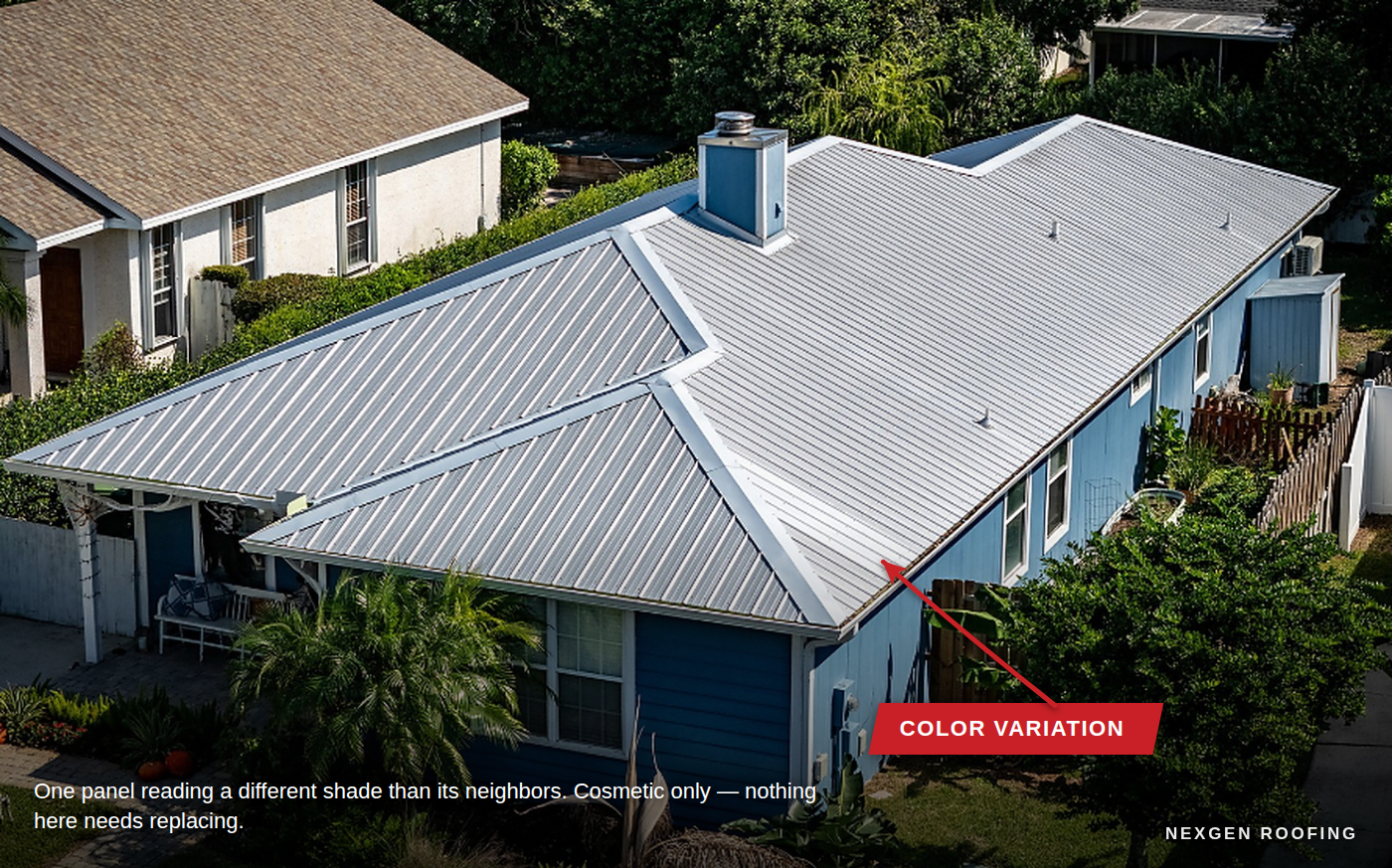
Coil is made in batches, and batches drift. Metal roofing starts as a coil, and both the substrate and the coating are produced in runs. Within a single run, color is held very tight. Between runs there's a published tolerance - small, but real - and separate runs can be weeks or months apart, with different pigment lots and slightly different coating thickness. Put two runs on one roof and you can get exactly what your photo shows: a boundary that follows the panel layout instead of the light.
Unpainted metal varies the most. A painted panel has pigment doing the work of holding the color steady. Bare Galvalume, mill-finish aluminum and acrylic-coated Galvalume have no pigment at all — what you're looking at is the metallic surface itself, including its spangle pattern and whatever oxide layer has formed. Spangle varies between coils, and the surface keeps changing as it weathers. Two batches that looked identical on the truck can read as two different grays a year later. A light silver roof is the hardest case in the whole category.
Same color name doesn't mean same color. Color names aren't standardized across the industry. One manufacturer's "ash gray" is not another's. If panels came from one supplier and the trim, an addition, or a later section came from another, they can be meaningfully different even though the paperwork says the same thing.
Material added later may not match. A roof that ran short mid-job, a change order, or a repair years on — all of it comes from a new run, onto a roof that has already started weathering.
So is it a problem? No. This is cosmetic and nothing else. The panels are the same product, they shed water the same way, they carry the same wind rating, and they'll last exactly as long as each other. Manufacturers publish color tolerances and state plainly that slight variation between production runs isn't a defect — that's not a dodge, it's what coating metal at industrial scale actually involves.
We don't recommend doing anything about it. Pulling and replacing sound panels over a shade difference means new penetrations, new flashing work and a fresh set of things to get wrong, in exchange for a cosmetic change that will shift again as the roof weathers. On an unpainted or light metallic roof the tones usually converge somewhat over the first few years anyway.
Where it's worth attention is before installation, not after. On a new roof, ordering the whole job at once from a single coil run costs nothing and avoids the situation entirely - and recording that run number gives any future repair the best chance of matching.
Part 3: What the panel is made of
Most people skip this part. It matters more than anything else on this page for whether your roof reaches the end of its warranty.
Galvalume steel is steel with a coating that's mostly aluminum and zinc. Away from the water it's a strong, proven, cost-effective choice, and substrate warranties usually run 25 to 40 years.
Aluminum doesn't rust. That's the whole point of it. Near saltwater it's the material that holds up, and its coverage generally doesn't shrink the closer you get to the ocean.
Copper and zinc look beautiful and last more or less forever, at two to three times the cost of painted aluminum. Most people use them on a small feature — an entry, a bay, a turret — rather than a whole roof.
If you live near the water, use aluminum
That's the short version, and for most coastal homes it's the whole answer.
Here's why it matters. Steel panels rust when salt reaches them, and manufacturers know it - so most Galvalume warranties are written to exclude homes within a certain distance of saltwater. The exact distance varies by manufacturer, product and finish, so the only way to know is to read the warranty for the specific panel you're being quoted. Inside that line, the coverage protecting against rust-through may not apply at all. A bit further out, some warranties still apply but with shorter terms — a 40-year substrate warranty cut to 25, a 35-year paint warranty cut to 20.
Aluminum avoids the whole question, because there's nothing in it to rust.
This covers a lot of our service area. Jacksonville Beach, Neptune Beach, Atlantic Beach, and Ponte Vedra Beach are the obvious ones, but Intracoastal-front homes from Palm Valley up through Queen's Harbour are in the same conversation - "distance from saltwater" usually includes brackish water, not just the ocean.
It's a property-by-property question, not a city-by-city one. Ask for the warranty document and check it against your address. It's a contract term, and you're entitled to read it before you sign.
One more thing worth asking about near the coast: the screws and the trim. Mixing metals in salt air causes corrosion, so fasteners and flashings should be stainless or otherwise compatible with the panel.
Gauge, briefly
Gauge is just how thick the metal is. For steel, 26 gauge is about 0.018 inches and 24 gauge is about 0.024 - so the bigger number means thinner metal. That's backwards, but it's the convention and nobody's fixing it.
Both are used across Northeast Florida and both can carry valid product approvals. Twenty-four gauge handles denting, foot traffic and waviness noticeably better, and it's the standard for standing seam. In aluminum, the comparable choice is .032 versus .040.
One thing worth knowing: gauge by itself doesn't set the wind rating. The tested assembly does.
Part 4: What the code requires
Florida Product Approval
Roofing products installed in Florida have to be approved by the state, and the documentation is public. Every approval has an FL number and a report showing the assembly was tested for uplift.
The word doing the work there is assembly. Approval isn't issued for "26-gauge metal" in general. It's for a specific panel, at a specific thickness, over a specific deck, with a specific underlayment and a specific screw pattern. Change the screw spacing and you've changed what the roof is approved to handle.
Ask for the FL number matching the assembly quoted for your house. Any metal installer has it on hand, and you can look up the report yourself in about two minutes.
Jacksonville's wind numbers
City code sets the design wind speed for a typical home at 125 mph west of a line that splits the county, and 130 mph east of it.
That line runs up the middle of the St. Johns River to the Fuller Warren Bridge, then follows I-95 north to the county line. For a lot of Jacksonville, the river is the boundary - so two houses ten minutes apart can fall under different requirements.
From there, the shape of your roof and how exposed the site is determine the actual pressures it has to handle.
Wind doesn't push a roof off so much as lift it - and the lift isn't spread evenly. It's strongest at the corners and along the edges, often two to three times what the middle of the roof sees. That's why screw and clip spacing tightens up in those zones, and why a roof that fails in a storm almost always starts at a corner.
- Corners — highest upliftAirflow separates hardest here and spins off into vortices, producing the lowest pressures anywhere on the building. Design pressures often run roughly two to three times the field.
- Eaves, hips and ridge — elevatedEvery line where the roof changes direction or ends. Fastener and clip spacing tightens through this band.
- Field — lowestThe broad middle of each plane, under the least load — and the part most people picture when they imagine wind damage.
Tear-off, or not
The code allows a metal recover over one existing layer of shingles when the deck is sound and the assembly is approved for it. That's real, and it's why metal-over-shingle gets promoted.
A second rule usually decides the matter, though. Under Florida Statute 553.844, replacing the roof on a site-built single-family home constructed before March 1, 2002 generally requires a secondary water barrier on the deck plus improved deck attachment — and neither can be installed with shingles in place. For a lot of older Jacksonville housing, that makes a recover impractical regardless of what the panel manufacturer allows.
A 2022 amendment narrowed the old 25 percent rule: if the existing roof was built or replaced under the 2007 Florida Building Code or later, only the portion being worked on has to meet current code. Permit history is what proves it, and your building official makes the call — so pull the permit record rather than guessing.
| System | Fasteners | Min. slope | Cost | Maintenance | Typical use here |
|---|---|---|---|---|---|
| Concealed fastener | |||||
| Mechanically seamed | Concealed clips | 1/2:12–1:12 | Highest | Minimal | Coastal, complex and low-slope roofs |
| Snap-lock | Concealed clips | 3:12 | High | Minimal | Most residential replacements |
| Nail strip | Concealed flange | 3:12 | Moderate | Minimal | Shorter runs, budget standing seam |
| Metal shingle / tile | Concealed interlock | 3:12 | High | Minimal | HOA and historic districts, tile look |
| Exposed fastener | |||||
| 5V crimp | Exposed | 3:12 | Low | Washers at 10–15 yrs | Cottage, farmhouse, simple gables |
| Corrugated | Exposed | 3:12 | Low | Washers at 10–15 yrs | Porches, outbuildings, accents |
| U-panel | Exposed | 3:12 | Low | Washers at 10–15 yrs | Garages, additions, workshops |
| R-panel / PBR | Exposed | 1/4:12–3:12 | Low | Washers at 10–15 yrs | Commercial and agricultural |
Staying long-term, inland. 24-gauge Galvalume snap-lock, striated pan, PVDF finish. Best long-run value in the category.
Within a mile of the Atlantic or Intracoastal. Aluminum, warranty terms in writing. The striated pan matters more here, since aluminum moves about twice as much as steel.
Any roof section under 3:12. Mechanically seamed double-lock, or a different system on those sections. Don't let anyone put a snap-lock or 5V panel on a slope its approval doesn't cover.
You want the crispest modern look. Smooth pan, narrow panel width, heavier gauge, lighter color, low gloss. That combination gives you the cleanest line with the best odds.
HOA or historic constraints. Stamped metal shingle or S-tile in aluminum.
Tight budget, simple gable roof. 5V crimp in 26-gauge Galvalume, inland — with the fastener maintenance planned for.
Shop, barn, or commercial building. U-panel for something less industrial, R-panel or PBR for maximum span and value.
Eight questions worth asking any roofer
You don't need to know roofing to ask these. They're the ones that actually tell you something.
1. Who's on my roof - your crew or a subcontractor?
Either can be fine. You just want to know who to call if something goes sideways, and whether the same people show up each day.
2. Whose panel is it, and where's it made?
Metal gets roll-formed by a specific manufacturer. Anyone who installs metal regularly names theirs without hesitating.
3. Is it steel or aluminum, and does that matter where I live?
Close to the water it matters a lot. Inland it usually doesn't. Either answer works - "I'm not sure" doesn't.
4. Are the screws hidden, or do they go through the face of the panel?
This is the single biggest difference in what you'll maintain later. Both are legitimate; they just age differently.
5. Is my roof going to look wavy?
Ask it exactly like that. Flat metal can ripple in certain light. A good answer covers what they'll do about it — panel width, thickness, the texture rolled into the panel.
6. What are the warranties — panel, paint, and your labor?
Three separate things with three separate lengths. Ask for copies before you sign, not after.
7. Are you pulling a permit, and will the city inspect it?
Yes is the only acceptable answer. That paperwork also protects you when you sell the house.
8. Can you show me the Florida approval for this exact roof?
Every metal system has a state-issued approval number proving it was tested for our wind speeds. Any real metal installer has it on hand and can pull it up in about thirty seconds.
You don't have to understand every answer. You'll learn plenty from how easily they come.
Metal is an excellent roof for a lot of Jacksonville homes, and the wrong roof for some of them. If you'd like a straight read on which combination fits your house, NEXGEN will come take a look. Free inspection and you'll get the answer if metal isn't right for you.
Schedule a metal roof consultation or call 904-802-7150.
NEXGEN Roofing - Owens Corning Platinum Preferred and GAF Certified Plus, serving Duval, Nassau, Flagler, and St. Johns counties since 2018.
